

A strong email marketing strategy starts with one idea: send each person something that feels written for them. Email is a powerful way to communicate with customers, share information, and promote products and services. However, with crowded inboxes and people quick to unsubscribe, it is harder than ever to win attention.
One way to address this challenge is through personalization. Personalization is the process of tailoring your marketing messages and communication to individual customers based on their preferences, interests, and behaviors. Done well, it can lift engagement, conversions and customer satisfaction.
In this blog post, we explain why personalization should sit at the centre of your email marketing strategy, how to do it right, and how to stay on the right side of privacy rules in India.
Benefits of Personalization in Your Email Marketing Strategy
1. Increased Engagement
Personalization is one of the most effective ways to increase engagement in any email marketing strategy. When customers receive an email that’s tailored to their interests and needs, they’re more likely to open up and engage with it. This is because personalized emails feel more relevant and valuable to the customer, making them more likely to take action, such as clicking on a link or making a purchase.
An often cited Experian email study found that personalized emails had 29% higher unique open rates than emails without personalization. Results vary by industry and audience, so always test with your own list.
2. Improved Conversions
Personalization can also lead to improved conversions, which means that customers are more likely to take the desired action, such as making a purchase, after receiving a personalized email. This is because personalized emails are more relevant and targeted, making them more likely to resonate with the customer and drive them towards a specific action.
The same Experian research reported transaction rates about six times higher for personalized emails. That is why conversion focused personalization is a core part of a modern email marketing strategy.
3. Higher Customer Satisfaction
A personal email marketing strategy also leads to higher customer satisfaction. When customers receive personalized emails that are tailored to their interests and needs, they’re more likely to feel valued and understood. This can lead to increased loyalty and advocacy, as well as a better overall customer experience.
A study by Accenture found that 75% of consumers are more likely to buy from a retailer that recognizes them by name, recommends options based on past purchases, or knows their purchase history. Similarly, a study by Segment found that personalized experiences lead to higher customer satisfaction and loyalty, with 49% of consumers saying they’ve made impulse purchases after receiving a personalized experience.
How to Build a Personalized Email Marketing Strategy
1. Collect Data
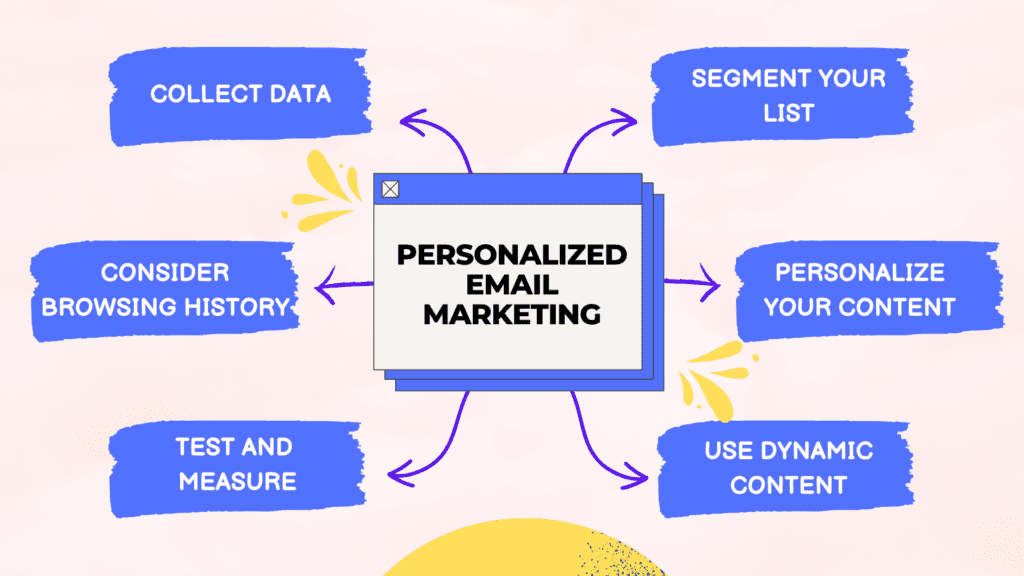
Every personalized email marketing strategy depends on good data. To personalize your emails effectively, you need to collect information on your customers. This data can include their name, location, purchase history, browsing behavior, and more. The more data you have, the more you can tailor your emails to their specific interests and needs.
Collect data directly and with consent, through sign up forms, preference centres, surveys and purchase history. Avoid buying email lists: they hurt deliverability, damage your sender reputation and can break privacy law.
2. Segment Your List
Once you’ve collected data on your customers, the next step is to segment your email list. Segmentation involves dividing your email list into smaller groups based on common characteristics or behaviors. This allows you to send more targeted and relevant emails to each group, increasing the chances of engagement and conversion.
Segmentation is where an email marketing strategy becomes practical. You can segment your list by location, purchase history, interests, and behavior. You can use your data to create different segments and tailor your email content to each group.
3. Personalize Your Content
Once you’ve segmented your list, the next step is to personalize your content. This involves tailoring your email content to each individual customer based on their interests, preferences, and behavior.
There are many ways to personalize your content, including using the customer’s name in the email, referencing their past purchases or browsing behavior, and recommending products or services based on their interests.
Timing and frequency matter in every email marketing strategy. Personalized emails are more effective when they’re sent at the right time and frequency. For example, you might send a personalized email with a discount code after a customer abandons their shopping cart or a personalized birthday email with a special offer.
4. Use Dynamic Content
Dynamic content is a type of content that changes based on the recipient’s characteristics or behavior. This can include images, text, and offers that change based on the customer’s location, past purchases, or interests.
Dynamic content can be highly effective in an email marketing strategy because it allows you to deliver personalized content without the need for manual segmentation or customization. Instead, the content is automatically generated based on the customer’s data.
5. Test and Measure
Finally, test and measure your personalized email campaigns. This involves tracking your email open rates, click-through rates, conversion rates, and other metrics to determine the effectiveness of your campaigns.
You can use A/B testing to compare different versions of your email campaigns and determine which one is more effective. This helps you refine your email marketing strategy over time.
Read More: Benefits of Personalised Email Marketing
Email Marketing Strategy and Privacy in India
India’s Digital Personal Data Protection Act, 2023 sets rules for how businesses collect and use personal data. Ask for clear consent, explain how you will use the information and make it easy to unsubscribe. You can find official information on the Ministry of Electronics and Information Technology website.
Large mailbox providers such as Gmail also expect bulk senders to authenticate their domain and offer one click unsubscribe. Following these rules protects your deliverability, so treat compliance as part of your email marketing strategy, not an afterthought.
Simple Personalization Ideas for Small Businesses
These ideas fit any size of email marketing strategy and need only the basic features of most email tools.
- Welcome series: greet new subscribers by name and share what they signed up for.
- Product follow ups: suggest related products a week after a purchase.
- Cart reminders: remind shoppers about items left in the cart, with a helpful note rather than pressure.
- Birthday or anniversary emails: send a warm message with a genuine offer.
- Language choice: let subscribers pick English or Hindi if your audience prefers it.
Start with one or two of these, measure the results and expand. A simple, consistent email marketing strategy beats a complex one you cannot maintain.
If you are building your list from scratch, our ebook Email List Management Secrets covers growing, cleaning and segmenting a list step by step.
Email Marketing Strategy Step by Step for Beginners
Personalization works best on top of a clear plan. If you are starting from zero, build your email marketing strategy in this order.
- Set one goal for the next three months, such as more repeat orders or more course sign ups.
- Choose an email tool with a free plan so you can start without a big cost.
- Add a sign up form to your website, your Instagram bio link and your checkout page, with a clear reason to join.
- Write a welcome series of two or three emails that introduces your brand and sets expectations.
- Decide how often you will send, for example one helpful email and one offer each month.
- Review your results every month and change one thing at a time.
Keep the first version of your email marketing strategy small. A two email welcome series that actually goes out is better than a perfect plan that never launches.
Worked Example: A Monthly Plan for a Small Online Shop
The numbers and names here are hypothetical, only to show how the pieces fit together. Imagine a handmade jewellery seller in Jaipur with 800 subscribers who joined from Instagram and past orders.
- Week 1: A styling tips email with three outfit ideas, sent to everyone.
- Week 2: A new collection email, with past buyers seeing pieces similar to what they bought before.
- Week 3: A festival gift guide, split by budget, with a reminder of delivery cut off dates.
- Week 4: A short thank you email to customers who ordered that month, asking for a review.
Every subscriber still gets about one email a week, but each segment sees something closer to its interests. That is how an email marketing strategy turns personalization into a routine instead of a one time trick.
Email Metrics That Matter
A good email marketing strategy tracks a few numbers well rather than every number badly. These are the ones to watch each month.
- Click rate: the share of recipients who clicked a link. This is usually more reliable than opens.
- Conversion rate: the share who bought, booked or signed up after clicking.
- Unsubscribe rate: a sudden rise means the content or frequency is off.
- Spam complaints: keep these close to zero, because they hurt future delivery.
- List growth: new subscribers minus people who left.
Treat open rates with care. Privacy features in some email apps load images automatically, so opens can look higher than real reading, which is why clicks and sales are better guides for your email marketing strategy.
Deliverability Basics Every Sender Should Know
Even the best email marketing strategy fails if messages land in spam. Set up SPF, DKIM and DMARC records for your domain, which most email tools guide you through in their help pages.
Send from your own domain rather than a free mailbox address, and keep your list clean by removing addresses that bounce. A steady sending schedule, a core part of any email marketing strategy, also builds trust with mailbox providers.
Free and Low Cost Tools To Start
You can run a solid email marketing strategy without paid software at first. Popular tools such as Brevo, Mailchimp, MailerLite and Zoho Campaigns offer free or entry plans, though their limits change, so check the current terms before you choose.
- A tool with segmentation by tags or groups.
- Simple automation for welcome and cart reminder emails.
- A signup form you can embed on your site or link from Instagram.
- Reports that show clicks and conversions per email.
Common Email Marketing Strategy Mistakes To Avoid
- Sending the same message to everyone, even after you have collected useful data.
- Using a first name field without a fallback, so some emails start with “Hi ,”.
- Emailing only when you want to sell, with no useful content in between.
- Adding people who never agreed to receive your emails.
- Making the unsubscribe link hard to find.
Email Marketing Strategy Checklist
Use this list before you press send on any campaign.
- The email goes to the right segment.
- The subject line is clear and honest about what is inside.
- Personal fields have a fallback value.
- Every link works and carries tracking tags.
- The email reads well on a phone screen.
- The unsubscribe link is visible.
Your First 30 Days Plan
- Week 1: Pick a tool, connect your domain and set up the signup form.
- Week 2: Write and switch on a welcome series of two or three emails.
- Week 3: Create your first two segments, such as buyers and non buyers, and send one tailored email to each.
- Week 4: Review clicks, sales and unsubscribes, then plan next month’s emails around what worked.
By the end of the month you will have a working email marketing strategy that you can grow one step at a time.
India Notes for Your Email Marketing Strategy
Plan around the festival calendar, such as Diwali, Raksha Bandhan and regional festivals, and send gift guides early enough for delivery. Give subscribers a choice of English or Hindi where your audience is mixed, and keep the tone friendly rather than formal.
Many Indian customers also use WhatsApp, so use email for longer content, receipts and guides, and keep WhatsApp for short updates people have agreed to receive. If you sell ebooks, templates or courses, our guide on how to sell digital products online in India explains how email fits into that business.
More Questions About Email Personalization
How many emails should a small business send each month?
There is no fixed number. Start with a pace your email marketing strategy can sustain, such as two to four emails a month, and watch unsubscribes and clicks before increasing.
Do I need a big list before personalizing?
No. Even a list of a hundred people can be split into buyers and non buyers. Small, relevant segments are a good place to start any email marketing strategy.
Is it legal to email customers who bought from me?
Under India’s data protection law, you should have a clear basis and consent for marketing messages. The safest approach is to ask for permission at checkout and always offer an easy way to opt out.
Conclusion
Personalization is the most powerful lever in an email marketing strategy. By tailoring your emails to each individual customer based on their interests, preferences, and behavior, you can increase engagement, improve conversions, and enhance customer satisfaction.
To do personalization right, collect data on your customers with consent, segment your list, personalize your content, use dynamic content, and test and measure your campaigns. With these steps, your email marketing strategy will drive real results for your business.
Read More: 10 Tips For Crafting Effective Email Marketing Campaigns
FAQs Related To Personalized Email Marketing
What is personalization in email marketing?
Personalization in email marketing refers to the practice of tailoring the content of an email to an individual customer based on their interests, preferences, and behavior.
What are the benefits of personalization in email marketing?
Personalization can increase email open rates, click-through rates, conversion rates, and customer satisfaction. It can also help to build stronger relationships with customers and improve brand loyalty.
How do I collect data on my customers for email personalization?
You can collect data on your customers through a variety of methods, including website analytics, social media, customer surveys, and purchase history.
How do I segment my email list for personalization?
You can segment your email list based on a variety of factors, including demographics, location, past purchases, and behavior on your website.
How do I personalize the content of my emails?
Personalizing the content of your emails involves tailoring your messaging to each individual customer based on their interests, preferences, and behavior. This can include using the customer’s name in the email, referencing their past purchases or browsing behavior, and recommending products or services based on their interests.
What is dynamic content in email marketing?
Dynamic content is a type of content that changes based on the recipient’s characteristics or behavior. This can include images, text, and offers that change based on the customer’s location, past purchases, or interests.
How can I measure the effectiveness of my personalized email campaigns?
You can measure the effectiveness of your personalized email campaigns by tracking your email open rates, click-through rates, conversion rates, and other metrics. You can also use A/B testing to compare different versions of your email campaigns and determine which one is more effective.
Read More: 7 Email Marketing Personalization Techniques for Every Marketer