
A neural network in machine learning, also known as an artificial neural network, is a type of model inspired by the structure and function of the human brain. These networks are used to learn patterns and relationships in data, and to make predictions or decisions based on that learning.
In this blog, we’ll explore what a neural network in machine learning is, how it works, the main types, and where you already use them every day.
What Is a Neural Network in Machine Learning?
Put simply, a neural network in machine learning is an interconnected network of artificial neurons that work together to process and analyze data. These networks are designed to mimic the way the human brain works, with multiple layers of neurons that can learn to recognize patterns and make decisions based on those patterns.
The basic building block of a neural network is an artificial neuron, which takes in one or more inputs and produces an output. Each input is weighted, and the neuron applies an activation function to the sum of the weighted inputs to determine the output.
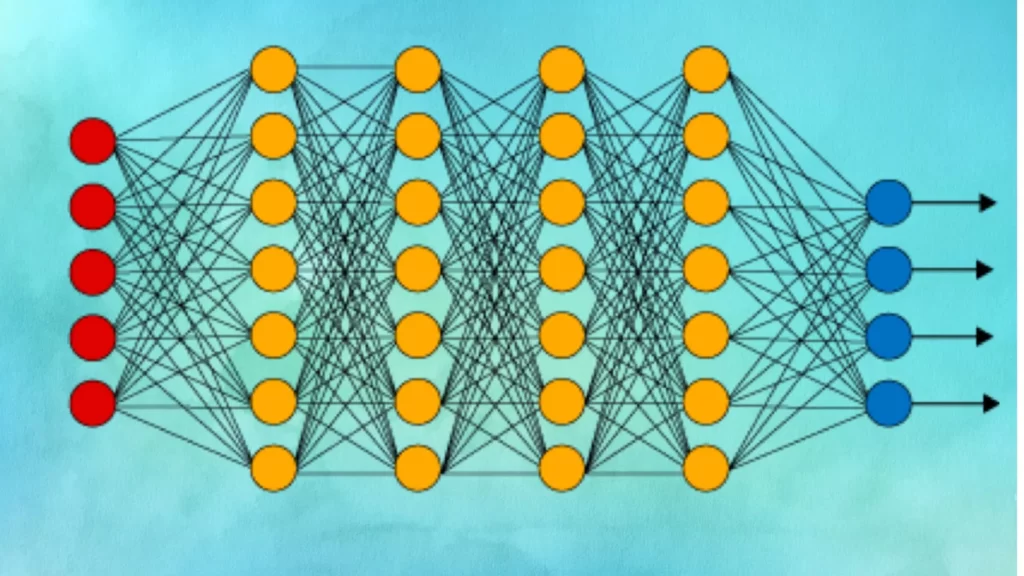
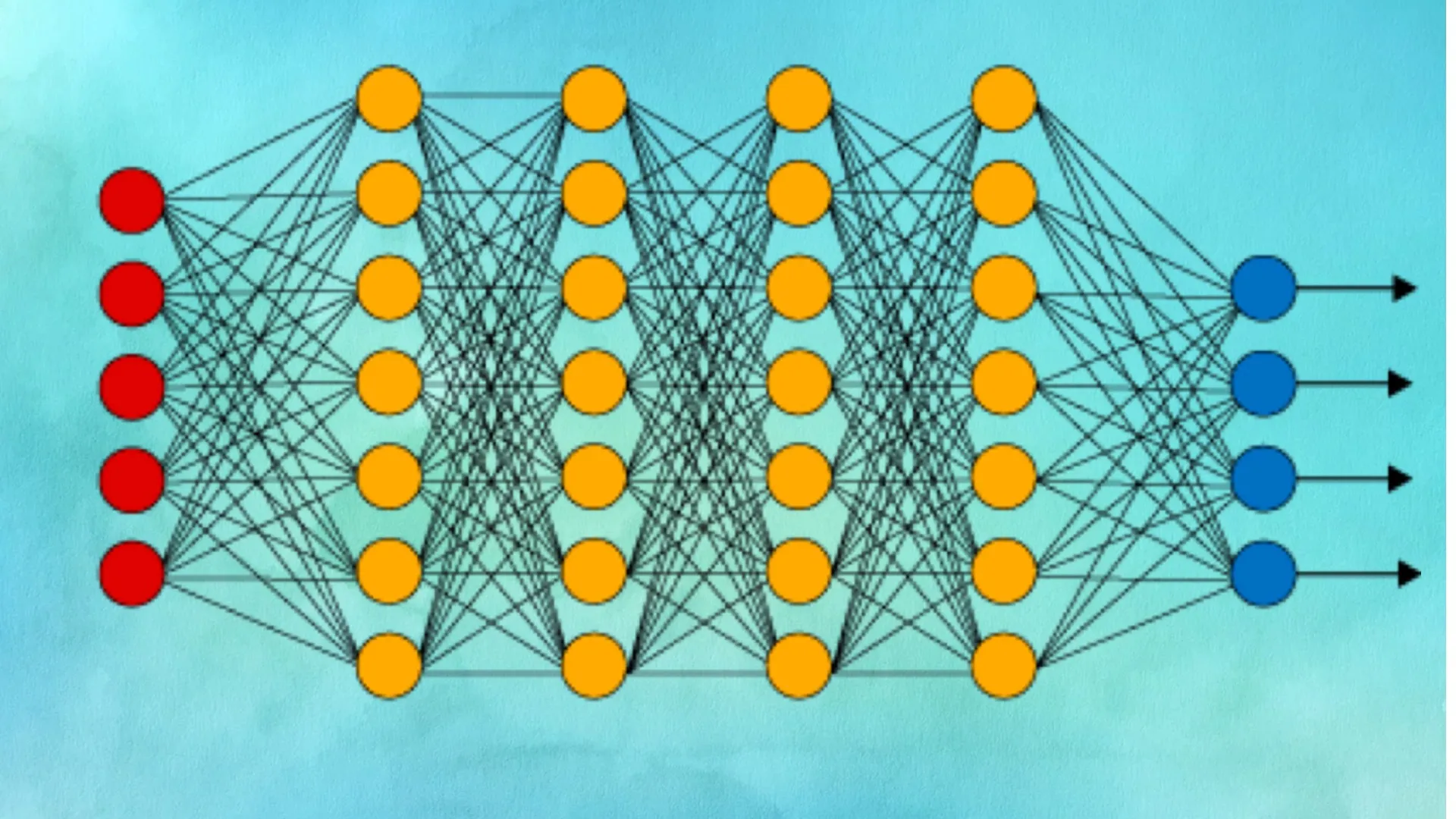
A neural network typically consists of multiple layers of neurons, with each layer processing and transforming the output of the previous layer. The first layer is the input layer, which takes in the raw data, and the last layer is the output layer, which produces the final prediction or decision.
In between the input and output layers, there may be one or more hidden layers, which perform intermediate calculations and learn to recognize more complex patterns in the data. The number of hidden layers and the number of neurons in each layer are hyperparameters that can be tuned to optimize the performance of the network.
Deep learning simply means a neural network in machine learning with many hidden layers. More layers let the model learn richer patterns, but they also need more data and computing power.
How Does a Neural Network in Machine Learning Work?
To understand how a neural network in machine learning works, let’s look at a simple example of image classification. Suppose we want to train a neural network to recognize handwritten digits. We start by feeding the network a large dataset of images of handwritten digits, with the correct label for each image.
The network then goes through a training process, where it adjusts the weights of the connections between the neurons to minimize the difference between its predicted output and the correct label for each image. This process is known as backpropagation, and it involves calculating the gradient of the error function with respect to the weights and adjusting the weights accordingly.
After the network has been trained on the dataset, it can be used to make predictions on new images. We feed the image into the input layer of the network, and the network produces a prediction at the output layer. The prediction is based on the patterns and relationships that the network has learned from the training data.
Key Terms Every Beginner Should Know
These words come up in every course and tutorial. Learning them early makes the rest of the topic much easier to follow.
- Weight: A number that says how strongly one input affects a neuron’s output. Training is mostly the process of adjusting weights.
- Bias: An extra number added inside a neuron that lets it shift its output up or down.
- Activation function: A simple rule applied after the weighted sum, such as ReLU or sigmoid, that lets the network learn curved, non linear patterns.
- Loss function: A score that measures how wrong the prediction was. Lower loss means better predictions on the training data.
- Backpropagation: The method used to work out how much each weight contributed to the error, so the weights can be nudged in the right direction.
- Epoch: One full pass of the training data through the network.
- Overfitting: When a model memorises the training data and performs badly on new data.
Each of these ideas appears in almost every neural network in machine learning, from a tiny classroom model to the systems behind modern chatbots.
A Tiny Worked Example of One Neuron
Imagine a neuron with two inputs, 2 and 3, and weights of 0.5 and 1. The weighted sum is 2 times 0.5 plus 3 times 1, which equals 4.
Add a bias of 1 and the total becomes 5. If the activation function is ReLU, which keeps positive numbers and turns negatives into zero, the output is simply 5.
A neural network in machine learning repeats this small calculation thousands or millions of times across its layers. Training changes the weights and biases so that the final outputs match the correct answers more often.
Types of Neural Network in Machine Learning
There are several types of neural network in machine learning, each with its own strengths and weaknesses. Here are some of the most commonly used types:
- Feedforward Neural Networks: These networks have a simple structure where the inputs are fed forward through the network to the output layer without any feedback loops. They are commonly used for classification and regression problems.
- Convolutional Neural Networks: These networks are specifically designed for image and video processing. They use a series of convolutional layers to detect patterns and features in the image, followed by one or more fully connected layers for classification or regression.
- Recurrent Neural Networks: These networks have feedback loops that allow them to process sequences of data, such as text or time series data. They are commonly used for natural language processing and speech recognition.
- Generative Adversarial Networks: These networks consist of two parts: a generator that creates new data based on the patterns learned from a training dataset, and a discriminator that tries to distinguish between the generated data and real data. They are commonly used for image and video generation.
- Autoencoder Neural Networks: These networks are used for unsupervised learning, where the goal is to learn a compressed representation of the input data. They consist of an encoder that compresses the input data into a lower-dimensional representation, and a decoder that reconstructs the original input from the compressed representation.
- Transformers: Introduced in 2017, these networks use a mechanism called attention to weigh how parts of an input relate to each other. They power large language models such as ChatGPT and Gemini, and many modern translation tools.

How to Build Your First Neural Network in Machine Learning Step by Step
You can train a small neural network in machine learning on a free cloud notebook without buying any hardware. The steps below follow the classic handwritten digit example that most beginner tutorials use.
- Open Google Colab: It gives you a free Python notebook in the browser, with libraries such as TensorFlow already installed.
- Load a dataset: The MNIST dataset of handwritten digits comes built into Keras and TensorFlow.
- Prepare the data: Scale pixel values to between 0 and 1 so training is stable.
- Define the model: Start with an input layer that flattens each image, one hidden layer with ReLU activation and an output layer with ten neurons, one for each digit.
- Compile: Choose an optimiser such as Adam, a loss function for classification and accuracy as the metric.
- Train: Fit the model for a few epochs and watch the loss fall.
- Evaluate: Test the model on images it has never seen, which is the honest measure of how well it learned.
- Experiment: Change the number of neurons, layers or epochs and see what happens to test accuracy.
This simple project teaches the full cycle of a neural network in machine learning: data, model, training and evaluation. Once it makes sense, try a convolutional network on the same data and compare the results.
Common Mistakes Beginners Make
- Jumping into advanced architectures before understanding a basic feedforward network.
- Checking accuracy only on training data and missing overfitting.
- Forgetting to scale or clean the input data.
- Training for too many epochs without watching validation results.
- Copying code without reading what each line does.
Most of these mistakes disappear when you keep a separate test set and change only one thing at a time. That habit matters more than any particular neural network in machine learning library.
Where You See a Neural Network in Machine Learning Every Day
- Face unlock on your phone and photo search in your gallery app.
- Voice assistants that turn your speech into text.
- Recommendations on YouTube, Instagram Reels and shopping apps.
- Spam filters in your email and fraud alerts from your bank.
- Google Translate and chatbots that reply in Hindi or English.
Each of these uses a neural network in machine learning trained on large sets of examples. That training is what lets them handle inputs they have never seen before.
Neural Network vs Traditional Machine Learning
Traditional methods such as decision trees or linear regression often work well on small, tidy tables of data and are easier to explain. Neural networks shine when the data is large and messy, like images, audio or text.
The trade off is that a neural network in machine learning needs more data and computing power. So start with a simpler model, and move to a neural network when the problem truly needs it.
How to Start Learning Neural Networks in 2026
- Brush up on basic algebra, probability and Python.
- Follow the free beginner tutorials from TensorFlow or PyTorch.
- Build a small project, such as a digit recogniser, using a public dataset.
- Read the Wikipedia overview of artificial neural networks for history and key terms.
If you create content about technology, our AI Tech Reels Bundle and our guide to AI in digital marketing show how these ideas reach everyday audiences.
Project Ideas for Practice
Once the digit recogniser works, small projects help the ideas stick. Each of these can be built with free datasets and a free notebook.
- Classify clothing images using the Fashion MNIST dataset.
- Predict whether a movie review is positive or negative from its text.
- Recognise simple hand gestures from images you collect yourself.
- Forecast a simple time series, such as daily temperatures, from public data.
Choose projects where you can explain the result to a friend. Explaining what a neural network in machine learning predicted, and why it sometimes fails, is the clearest sign you have understood it.
Write a short summary of each project with the data used, the model, the accuracy and what you would try next. Over time, this becomes a simple portfolio that shows your learning honestly.
Free Tools and Courses to Learn Neural Networks
You do not need to pay for expensive courses to understand the basics of a neural network in machine learning. These free resources are widely used by learners around the world.
- Google’s Machine Learning Crash Course: A free course with short lessons and exercises, available on Google for Developers.
- TensorFlow and PyTorch tutorials: Official beginner guides with ready to run code.
- Google Colab: Free notebooks in the browser, so you can practise on any laptop.
- Kaggle: Public datasets, notebooks and beginner competitions to practise on real problems.
- NPTEL: Free online courses from Indian institutes, including several on machine learning and deep learning.
Pick one main course and finish it before starting another. Jumping between many resources is a common reason learners stall.
A 30 Day Plan to Learn a Neural Network in Machine Learning
Thirty days is enough to understand the basics and finish one small project, if you study a little every day.
Week 1: Revise Python basics, NumPy arrays and simple algebra such as vectors and matrices.
Week 2: Learn the key terms above, and watch or read how a single neuron and a small network learn.
Week 3: Build the digit recogniser in Google Colab, following the steps in this guide.
Week 4: Improve your model, write a short note on what you changed and why, and share the notebook on GitHub or Kaggle.
At the end of the month, you will understand how a neural network in machine learning learns from data, which is a strong base for deep learning later.
FAQs About Neural Networks
Do I need advanced maths to learn neural networks? Basic algebra, a little probability and the idea of slopes from calculus are enough to begin. Libraries handle most of the heavy calculations for you.
Can I learn neural networks without a powerful computer? Yes. Free cloud notebooks such as Google Colab let you train small models in the browser.
Is deep learning the same as a neural network in machine learning? Deep learning refers to neural networks with many hidden layers. Every deep learning model is a neural network, but not every neural network is deep.
How long does it take to understand a neural network in machine learning? With regular practice, many learners grasp the basics in a few weeks, while real confidence comes from building several projects over months.
Which language is best for neural networks? Python is the most common choice, because TensorFlow, PyTorch and most tutorials use it.
Conclusion
In conclusion, a neural network in machine learning is a powerful tool for analyzing and making predictions based on complex data. By mimicking the structure and function of the human brain, these networks can learn to recognize patterns and relationships in data and make decisions based on that learning.
There are many different types of neural networks, each with its own strengths and weaknesses, and the choice of the network will depend on the specific problem and data being analyzed.
As machine learning continues to advance, we can expect to see more sophisticated neural network architectures and techniques being developed, and new applications of this technology in a wide range of fields.
Read More: What Is Machine Learning Neural Networks?